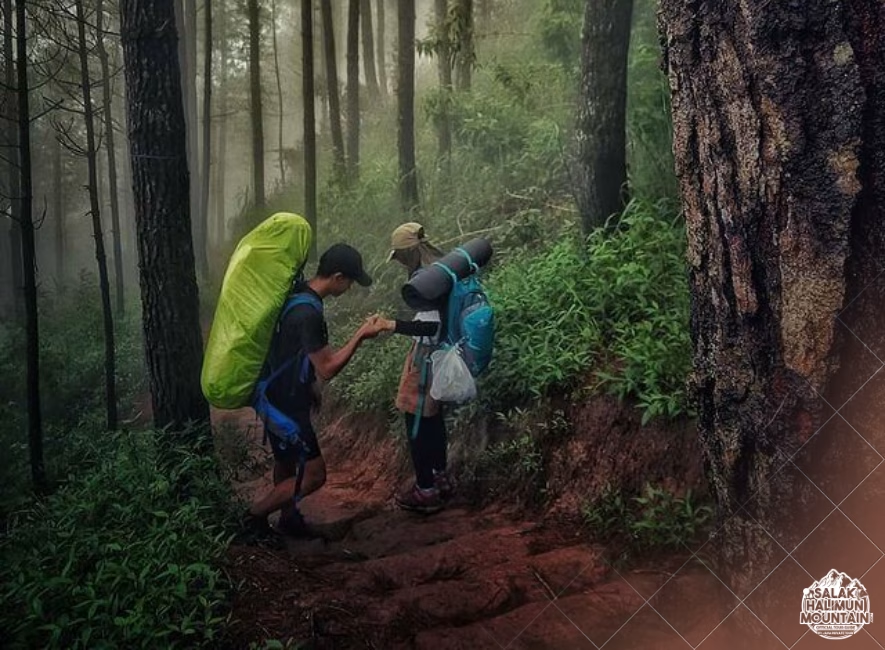
salakhalimunmountain.com – Climbing high into the steep rainforest slopes of Mount Salak is a physical experience that engages every muscle in your lower body almost immediately. As soon as you leave the lower agricultural borders and step into the dense jungle interior, the trail tilts upward sharply. Thick humidity hangs heavy in the air, the canopy closes overhead, and the path transforms into a continuous wall of damp mud, elevated root steps, and steep clay embankments. Ascending these high-gradient rainforest paths is entirely different from walking on a paved incline or a dry mountain trail. It requires your body to continuously adjust to shifting, uneven surfaces while fighting the pulling force of gravity.
To an untrained hiker, climbing a steep jungle ascent often feels like an exhausting cycle of slipping, straining, and burning out leg muscles within the first hour. However, if you watch experienced local guides move up the exact same mountain faces, their movement looks surprisingly relaxed and effortless. They are not necessarily stronger or carrying lighter packs. Instead, they understand the biomechanics of steep jungle ascents. By mastering how your joints, muscles, and center of gravity interact with the terrain, you can conserve immense amounts of energy, protect your knees and lower back, and climb with steady confidence.
Understanding the Bio-Kinematic Shift on High Incline Trails
When you walk on flat ground, your body moves forward using a natural, low-energy rolling gait. Your heels strike the earth, your weight rolls forward along the arch, and your toes push off to launch the next step. But the moment a rainforest trail exceeds a twenty-degree incline, that horizontal movement model breaks down completely. Your hip flexors have to lift your legs much higher, your ankles flex sharply to adapt to the slope, and your quadriceps take on the heavy load of lifting your body weight vertically with every single stride.
On the slick, uneven ground of Mount Salak, this extra physical load is multiplied by surface instability. If your foot slips even an inch backward during a step, your leg muscles fire extra nerve signals to stabilize your joints, consuming vital energy reserves. Understanding how to align your kinetic chain—from your ankles up through your knees, hips, and spine—is the key to eliminating wasted effort and maintaining a sustainable climbing pace.
Managing Joint Angles to Prevent Muscle Burnout
The biggest cause of early muscle exhaustion on steep ascents is over-flexing the knee joint under heavy load. When you take long strides up a high embankment, your knee bends deeply, pulling your hip far below your lead foot. In biomechanics, this creates a long lever arm, forcing your quadriceps and knee cap to work at a severe mechanical disadvantage to straighten your leg.
To fix this, shorten your stride dramatically on steep sections. Take small, compact steps where your lead foot lands directly beneath your center of hips rather than far out in front of your body. By keeping your knee flex flexed at a shallower angle, your powerful gluteal muscles and hamstrings take over the lifting effort, pulling your weight up efficiently while protecting your knee joints from excessive stress.
Mastering Foot Alignment and Weight Distribution
Foot placement is the foundation of biomechanical efficiency on wet jungle paths. On steep sections of Mount Salak, the trail surface is rarely flat or uniform. You are constantly stepping across angled tree roots, slick clay ledges, and uneven rocks. How you plant your boot sole determines how much friction you create against the slope.
A common mistake when climbing steep hills is toe-stepping, or placing only the front ball of your foot on a ledge while your heel hangs unsupported in open air. Toe-stepping forces your calf muscles and Achilles tendons to stay under continuous isometric tension to keep your body balanced. Within minutes, your calves will begin to burn and tremble from fatigue.
The Whole-Sole Contact Principle
Whenever you step up onto a ledge, root step, or mud bank, aim to plant your entire boot sole flat against the surface. Getting your heel fully supported on solid earth allows your skeletal structure to carry your body weight rather than forcing your calf muscles to do all the work. If the slope is too steep for a flat heel landing, turn your feet slightly outward at a subtle angle, adopting a wide stance that broadens your base of support.
When shifting your weight onto your lead leg, drive your power straight down through your heel rather than pushing backward off your back toes. Pushing straight down into the mountain increases the downward force between your boot sole and the ground. This physical dynamic increases traction on wet earth, keeping your foot locked in place while your leg straightens smoothly.
Posture, Spine Alignment, and Upper Body Mechanics
Your lower body carries the main burden of climbing, but your upper body posture dictates how easily you breathe and how stable your balance remains on steep inclines. When fatigue sets in on a long climb up Mount Salak, instinct often causes hikers to hunch forward at the waist, folding their chest down toward the trail face.
While leaning slightly into the hill is natural on steep terrain, excessive bending at the waist is terrible for your movement mechanics. Hunching over compresses your diaphragm and chest cavity, reducing lung capacity right when your body needs maximum oxygen. It also forces your lower back muscles to work extra hard to keep your heavy backpack from pulling you backward off balance.
Maintaining an Upright Kinetic Axis
Keep your spine long and relatively straight, hinging forward slightly from your ankles and hips rather than rounding your upper back. Think of keeping your chest open and your head lifted so your eyes gaze two to three steps ahead on the trail. This posture allows your lungs to expand fully with every breath, delivering fresh oxygen to your working muscles.
Engage your core muscles lightly throughout the ascent. A stable, braced torso acts as a solid bridge between your upper body and legs, preventing your hips from swaying sideways on slick mud. This keeps your momentum moving forward and upward in a straight line, saving valuable energy with every step.
Trekking Poles as Biomechanical Force Multipliers
Using a pair of lightweight trekking poles correctly completely changes the physical demands of a steep jungle ascent. Poles turn your body from a two-point movement system into a four-point engine, redistributing a significant percentage of your body weight and pack load to your upper body muscles.
When climbing steep rainforest slopes, adjust your trekking poles slightly shorter so you do not have to reach uncomfortably high above your shoulders to plant them. Plant the tips of your poles firmly into stable dirt spots slightly behind your lead foot. As you step up with your leg, push down through the pole handles using your upper back, shoulders, and triceps.
Relieving Pressure on Lower Joints
Biomechanical studies show that using trekking poles on steep ascents reduces the physical load on your lower back, knees, and hips by up to twenty percent. On a multi-hour climb up Mount Salak, that reduction adds up to thousands of pounds of force saved off your legs. Poles also offer instant lateral stability if your boot slips on a wet root, catching your balance before your knee or ankle experiences sudden twisting forces.
Avoid gripping your pole handles with excessive tension, as tight hands waste energy and cause forearm fatigue. Relax your grip, make full use of the pole wrist straps to transfer your body weight, and let your arm swing match the natural rhythm of your legs.
Breathing Cadence and Sustainable Energy Pacing
The physical effort of climbing steep rainforest trails pushes your cardiovascular system hard. High heat, heavy humidity, and steep inclines can cause your heart rate to spike quickly if you try to maintain a flat-ground walking speed. Maintaining a sustainable physical pace is just as important as proper foot mechanics for reaching high ridges safely.
Sync your breathing directly to your footsteps. A simple, effective cadence is inhaling for two small steps and exhaling for two small steps. If the trail becomes exceptionally steep, switch to a one-to-one rhythm: one breath per step. This rhythmic breathing pattern supplies a steady flow of oxygen to your legs while keeping your heart rate within a sustainable aerobic zone.
Embracing the Slow, Unstoppable Rhythm
Local rainforest guides have a saying: climb like an old person to arrive like a young person. Resisting the urge to rush up steep incline sections prevents rapid lactic acid build-up in your leg muscles. Taking small, steady, methodical steps without stopping every few minutes is far more efficient than sprinting up fifty yards and collapsing against a tree to catch your breath.
By listening to your body, maintaining clean movement mechanics, and adopting a steady pace, the steepest jungle slopes on Mount Salak transform from exhausting obstacles into a deeply rewarding physical practice. You move in harmony with the mountain, enjoying the lush canopy and wild forest air every step of the way.
So, if you’re ready to explore the wonders of Mount Salak Halimun, head over to our ONLINE BOOKING PAGE and let’s start planning your adventure. Or simply CLICK THIS LINK to chat with us on WhatsApp.
With our team, you’re not just getting a guide; you’re gaining a local friend who will ensure your trip is nothing short of extraordinary.